


RAV4 Prime vs RAV4 Hybrid Comparison for Toyota SUV Shoppers
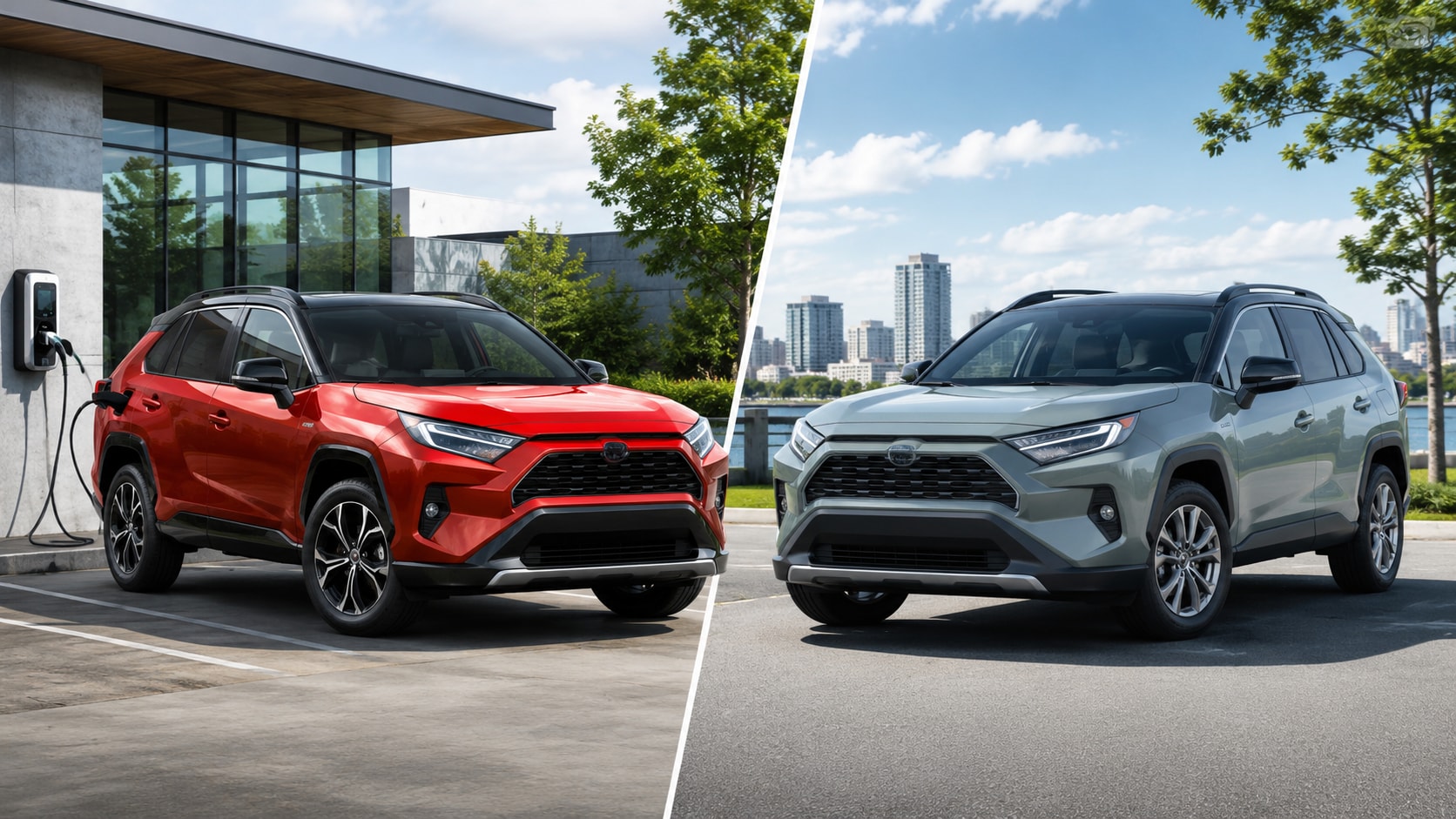
Choosing between the RAV4 Prime vs RAV4 Hybrid comes down to one core question: do you want to plug in for extra electric range and power, or do you want lower upfront cost with no charging required? Both are excellent compact SUVs, but they serve different driving habits and budgets.
This guide breaks down the real differences in price, fuel economy, electric range, performance, and ownership costs, so you can decide which Toyota fits your life. Note that Toyota has rebranded the RAV4 Prime as the RAV4 Plug-in Hybrid (PHEV) in the redesigned lineup, though many shoppers still search for it under the "Prime" name.
RAV4 Prime vs RAV4 Hybrid: Quick Answer
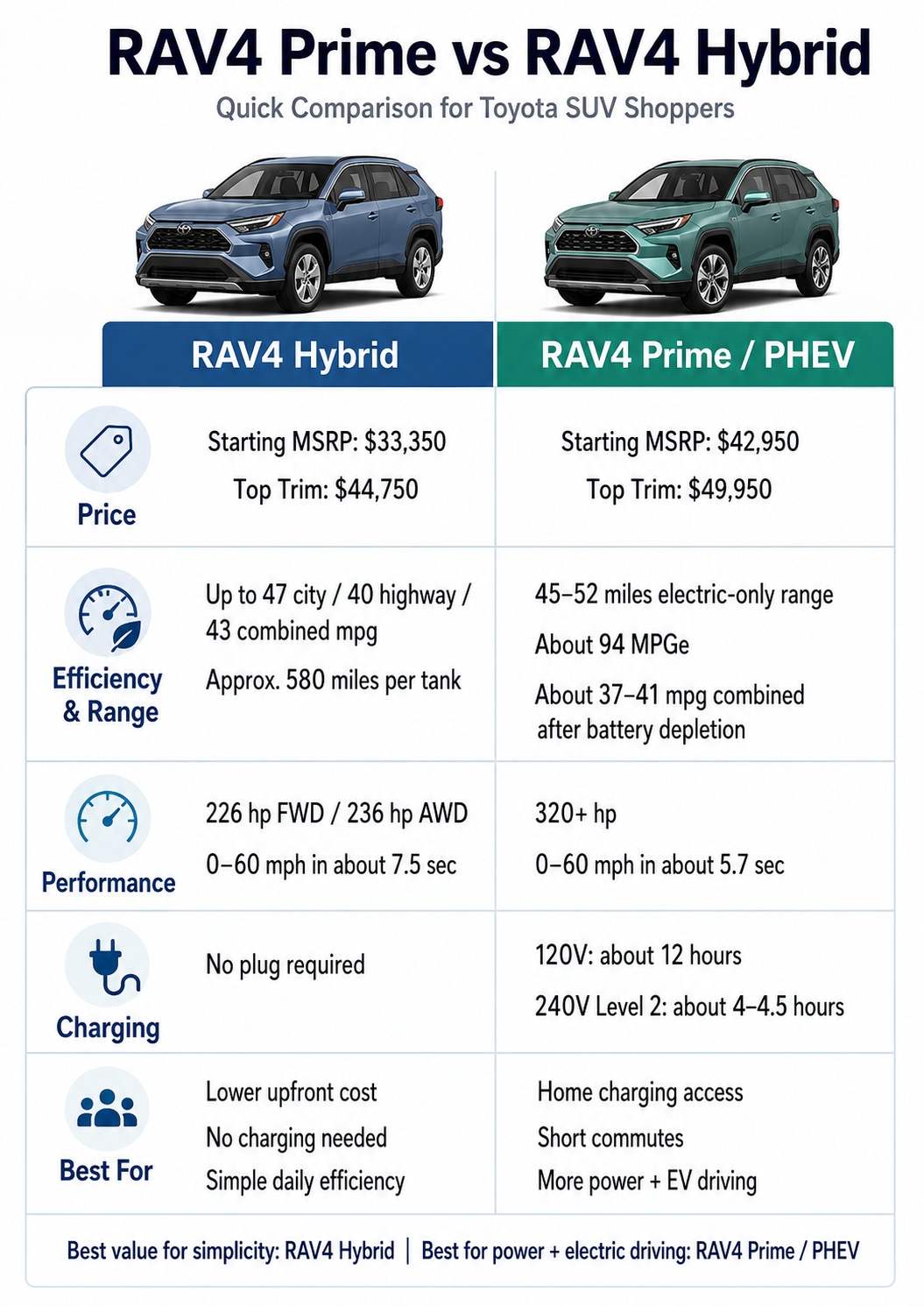
The RAV4 Hybrid is a self-charging hybrid that runs on gasoline and electric power together, requires no plug, and starts at a lower price. The RAV4 Prime (now called the RAV4 Plug-in Hybrid) uses a larger battery you charge externally, delivers significantly more horsepower, and can travel about 45–52 miles on electric power before the gas engine kicks in.
If your daily drive is short and you can charge at home, the Prime saves more on fuel. If you want simplicity and a lower sticker price, the Hybrid is the better fit.
What's the Difference Between RAV4 Prime and RAV4 Hybrid?
 âÂÂÂÂ
âÂÂÂÂ
The core difference is the battery and how it's charged.
The RAV4 Hybrid pairs a 2.5-liter four-cylinder engine with electric motors. The battery recharges itself through regenerative braking and the gas engine — you simply fill the tank like a normal car.
The RAV4 Prime/PHEV uses the same basic hybrid layout but adds a much larger battery pack that you plug in to a wall outlet or home charger. This lets it drive on electricity alone for daily errands and short commutes, switching to hybrid mode automatically once the battery depletes.
In practice, this means the Hybrid is built for drivers who want efficiency without changing their routine, while the Prime/PHEV is built for drivers who can plug in overnight and want to minimize gas station visits.
Price Comparison
Pricing is one of the biggest differentiators between these two SUVs.
The Prime/PHEV typically costs $8,000 to $10,000 more than a comparable Hybrid trim. That gap narrows over time through fuel savings and potential federal or state EV incentives for plug-in hybrids, but the upfront cost difference is real and worth budgeting for.
Fuel Economy and Electric Range
This is where the two models diverge most.
RAV4 Hybrid:
-
Up to 47 mpg city / 40 mpg highway / 43 mpg combined on FWD trims
-
AWD trims range from roughly 38–42 mpg combined depending on configuration
-
No plug-in capability; runs entirely on gasoline and self-generated electric assist
-
Roughly 580 miles of range on a full 14.5-gallon tank under ideal conditions
RAV4 Prime / PHEV:
-
Up to 45–52 miles of electric-only driving range, depending on trim
-
After the battery depletes, it runs as a standard hybrid, returning roughly 37–41 mpg combined
-
Combined fuel-and-electric efficiency reaches the equivalent of roughly 94 MPGe
For context, a driver with a 30-mile round-trip commute and home charging access could complete most weekday driving on electricity alone in the Prime/PHEV, rarely visiting a gas station except on longer trips.
Performance: Which One Is Faster?
Horsepower and acceleration are not close.
The RAV4 Hybrid produces around 226 horsepower with front-wheel drive or 236 horsepower with all-wheel drive, reaching 60 mph in roughly 7.5 seconds — solid for a compact SUV.
The RAV4 Prime/PHEV delivers a combined 320+ horsepower, with Toyota quoting a 0-60 time of around 5.7 seconds. That's quicker than many sport sedans and noticeably more responsive when merging or passing, thanks to instant torque from the electric motors.
If acceleration and a sportier feel matter to you, the Prime/PHEV has a clear edge.
Charging Requirements: Do You Need a Charger?
The RAV4 Hybrid requires no charging at all. There's no plug, no home charger to install, and no need to think about range anxiety — it behaves exactly like a traditional gas vehicle, just with better mpg.
The RAV4 Prime/PHEV needs access to charging to get the most value from it:
-
A standard 120-volt household outlet works but takes around 12 hours for a full charge
-
A 240-volt Level 2 home charger reduces that to roughly 4–4.5 hours
-
Installing a Level 2 charger typically costs $500–$1,500 depending on your home's electrical setup
If you live in an apartment or condo without reliable charging access, the Prime/PHEV loses much of its advantage, since you'd often be running it as a heavier, more expensive hybrid.
Which One Should You Buy?
Choose the RAV4 Hybrid if you:
-
Want the lowest upfront price
-
Don't have consistent access to home or workplace charging
-
Prefer the simplicity of refueling like a normal car
-
Still want strong fuel economy without changing your routine
Choose the RAV4 Prime/PHEV if you:
-
Have a daily commute under 40–50 miles and can charge at home overnight
-
Want significantly stronger acceleration and performance
-
Are eligible for plug-in hybrid tax incentives in your state
-
Plan to keep the vehicle long enough for fuel savings to offset the higher purchase price (typically 5–6 years)
A practical way to think about it: the Hybrid rewards drivers who want to "set it and forget it," while the Prime/PHEV rewards drivers willing to build a charging habit in exchange for lower running costs and more power.
Not sure which RAV4 fits your driving habits?
Schedule a test drive at Malone Toyota to compare the Hybrid and Prime/PHEV side by side, or talk with our team about current pricing and incentives on both models.
Frequently Asked Questions
1. Is the RAV4 Prime worth the extra money over the Hybrid?
It depends on your commute and charging access. If you can charge at home and drive less than 45 miles per day, the Prime/PHEV can run mostly on electricity, which offsets its higher price over several years through fuel savings. If you lack charging access, the price premium is harder to justify.
2. Can you drive the RAV4 Prime without ever plugging it in?
Yes, but you lose most of its advantage. Without charging, the Prime/PHEV operates as a heavier hybrid with lower combined mpg than the standard RAV4 Hybrid, so skipping the plug defeats its purpose.
3. Does the RAV4 Hybrid qualify for any tax credits?
Generally, no — standard hybrids typically don't qualify for federal EV incentives. Plug-in hybrids like the RAV4 Prime/PHEV may qualify for certain state or federal incentives depending on battery size and current regulations, so it's worth checking eligibility at the time of purchase.
4. How much does it cost to charge a RAV4 Prime at home?
Charging cost depends on local electricity rates, but a full charge typically costs a few dollars — far less than the equivalent amount of gasoline for the same driving distance.
5. Is the RAV4 Hybrid good enough for most daily driving needs?
Yes. With up to 43 mpg combined and no charging required, the RAV4 Hybrid covers the needs of most commuters and families without any change to driving habits.
RAV4 Prime vs RAV4 Hybrid: Final Verdict
The RAV4 Hybrid is the better choice if you want lower upfront cost, strong MPG, and no charging required. The RAV4 Prime, now called the RAV4 Plug-in Hybrid, is the better fit if you can charge at home, drive shorter daily trips, and want more power with electric-only range.
For most Toyota SUV shoppers, the right choice comes down to budget, charging access, and daily driving needs.
Categories:
Social
